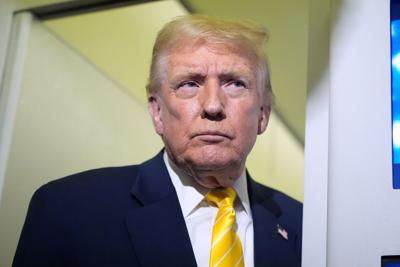
New York (CNN) 鈥� President Donald Trump has drafted an executive order that would block states from enforcing regulations around artificial intelligence, renewing an AI deregulation push that鈥檚 raising concerns among tech safety advocates and state lawmakers on both sides of the aisle.
The draft order directs the US attorney general to establish an AI Litigation Task Force to challenge state AI laws and preempt them with Trump鈥檚 more lax federal policy, according to a copy viewed by CNN.
The fast-moving technology is already subject to little oversight as it extends into more areas of life 鈥� from personal communications and relationships to health care and policing. In the absence of broad federal legislation, some states have passed laws to address potentially risky and harmful uses of AI, such as the creation of misleading deepfakes and algorithmic discrimination in hiring. Critics of the preemption push worry that if left unchecked, AI companies could evade accountability should their tools harm consumers.
Asked for comment about the pushback, a White House official told CNN that until officially announced by the White House, discussion about potential orders is speculation.
The language in Trump鈥檚 draft order mirrors the argument from some in the tech industry, including OpenAI CEO Sam Altman, that navigating a patchwork of state laws would slow down innovation and could affect America鈥檚 competitiveness.
鈥淚t is the policy of the United States to sustain and enhance America鈥檚 global AI dominance through a minimally burdensome, uniform national policy framework for AI,鈥� the draft order states.
Trump also suggested adding language blocking state AI regulations to the National Defense Authorization Act, the annual defense policy bill, in a Tuesday on Truth Social.
Congress killed an earlier attempt by Republicans to prevent states from regulating AI in July. The US Senate voted nearly unanimously to remove a 10-year moratorium on the enforcement of state artificial intelligence regulations from Trump鈥檚 sweeping domestic policy bill before the bill passed. Weeks later, the Trump administration released a Silicon Valley-friendly , a package of initiatives and policy recommendations that largely centered on scaling back AI regulation to promote US competitiveness.
While some in Silicon Valley may support easing up on AI regulation, the proposal has received broad pushback as concerns about AI safety have escalated in recent months. A growing have highlighted risks of the technology causing or contributing to among users. Companies like OpenAI and Meta have also been scrambling to from accessing adult content via AI systems.
Florida Governor Ron DeSantis called the effort 鈥渇ederal government overreach鈥� in a Tuesday on X.
鈥淪tripping states of jurisdiction to regulate AI is a subsidy to Big Tech and will prevent states from protecting against online censorship of political speech, predatory applications that target children, violations of intellectual property rights and data center intrusions on power/water resources,鈥� he said.
Democratic Senator Ed Markey called out Republicans for 鈥渢rying to sneak their AI regulation moratorium into the defense bill鈥� and accused Trump of siding 鈥渨ith his billionaire Big Tech buddies,鈥� in an X Wednesday.
The renewed preemption push comes as Trump hosted a dinner at the White House this week for business leaders, which was attended by many AI industry leaders, including Elon Musk, Nvidia CEO Jensen Huang, OpenAI President Greg Brockman and tech investor and White House AI and Crypto Czar David Sacks.
Hundreds of organizations 鈥� including tech employee unions and other labor groups, tech safety and consumer protection nonprofits and educational institutions 鈥� this week opposing the idea of blocking state AI regulations and raising alarms about AI safety risks.
鈥淭his draft executive order isn鈥檛 about interstate commerce or American competitiveness,鈥� Alejandra Montoya-Boyer, vice president of The Leadership Conference鈥檚 Center for Civil Rights and Technology, said in a statement. 鈥淚t鈥檚 about giving the administration鈥檚 tech billionaire buddies and corporations a free pass rather than protecting the people it鈥檚 meant to serve.鈥�
J.B. Branch, big tech accountability advocate at the consumer protection nonprofit Public Citizen, noted in a statement that 鈥淎I scams are exploding, children have died by suicide linked to harmful online systems, and psychologists are warning about AI-induced breakdowns鈥� and that blocking state regulations could 鈥渟hield Silicon Valley from responsibility.鈥�
The-CNN-Wire
鈩� & 漏 2025 Cable News Network, Inc., a Warner Bros. Discovery Company. All rights reserved.