
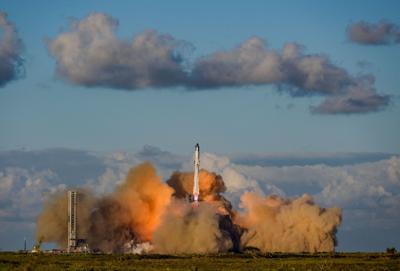


(CNN) 鈥� SpaceX鈥檚 luck appears to be turning, as the company notched a second straight of the Starship launch system 鈥� the most powerful rocket ever constructed 鈥� on Monday evening.
The test mission, which kicked off around 6:23 p.m. CT at SpaceX鈥檚 facilities in South Texas, marked the final showing for Starship Version 2, or V2, which SpaceX will now retire in favor of another, slightly larger and more powerful prototype called Version 3.
The V2 test campaign began in January and was marked by a string of explosive, in-flight failures 鈥� with one vehicle exploding during a ground test and three others erupting into flames mid-flight 鈥� followed by a surprising redemption arc.
Despite recent successes, however, SpaceX has a long way to go before Starship is ready to set out on an operational mission.
And the plans for this vehicle are nothing less than transformational: SpaceX CEO Elon wants Starship to carry humans to Mars for the first time. NASA also plans to use the vehicle to as soon as 2027 amid a new space race with China 鈥� a goal that is putting SpaceX and Starship in the hot seat as the space agency鈥檚 deadline rapidly approaches.
With those lunar dreams looming, here are six takeaways from the pivotal vehicle鈥檚 11th test flight.
SpaceX teases a return to eye-catching booster landings
After using most of its fuel and propelling Starship toward space, the Super Heavy on Monday safely broke away from the upper Starship spacecraft and veered back toward Earth.
For this test mission, Super Heavy made a controlled splashdown in the ocean just east of Texas. But the vehicle completed maneuvers designed to help engineers hash out how an upgraded Version 3 iteration of Starship will land back in the arms of SpaceX鈥檚 massive launch tower.
SpaceX completed a couple show-stopping test runs of this capability on earlier test flights. But it has now been months since the company has attempted to bring Super Heavy back to dry land. Today鈥檚 flight offers a glimmer of hope that a V3 booster catch could be on the horizon.
We got a jaw-dropping glimpse into Starlink鈥檚 potential future
After breaking away from Super Heavy, the Starship spacecraft lit up its own six engines and soared into space. As the vehicle moved through its flight path, it carried out a couple of crucial tests.
The first was to deploy a series of dummy satellites, which were meant to simulate how Starship will one day send real versions of SpaceX鈥檚 Starlink internet-beaming satellites into orbit through a horizontal hatch in the side of the vehicle.
The test was a success, and on SpaceX鈥檚 livestream of the launch, one of the hosts noted that 鈥� when Starship is operational 鈥� it will haul batches of about 60 Starlink satellites to orbit at a time.
鈥淪tarship will deploy Starlink鈥檚 more advanced V3 satellites, adding 60 terabits per second of capacity to the network per launch,鈥� said Amanda Lee, a build reliability engineer at SpaceX, during the webcast. 鈥淭hat鈥檚 20 times more than each Falcon 9 launch does today. Just incredible.鈥�
Starship made strides toward unprecedented reusability
Shortly after completing the satellite demonstration, the Starship spacecraft relit one of its six engines mid-flight.
That test, previously accomplished on Flight 6 and Flight 10, was designed to simulate how Starship will conduct a deorbit burn, or a maneuver intended to steer the vehicle back toward dry land after it finishes its mission in space.
鈥淭his will be a critical capability,鈥� SpaceX spokesperson Dan Huot noted on the webcast, because the company intends to one day recapture and refly the spacecraft to drive down costs.
Unlike any other rocket that has ever flown, Starship is intended to be rapidly reused from top to bottom. That means SpaceX wants to bring both the Super Heavy rocket booster and Starship spacecraft safely home after flight.
And SpaceX is really figuring out how to do this from scratch. No other launch system is built quite like this: Starship essentially acts as both the second stage of a rocket and as its own spacecraft. Never has a rocket鈥檚 upper stage been safely returned from orbit, in part because the jarring physics of plunging back into Earth鈥檚 atmosphere while traveling more than 17,000 miles per hour can easily rip a vehicle apart if not meticulously planned.
The spacecraft out-performed expectations
After the engine test, Starship began to plunge back into Earth鈥檚 thick inner atmosphere.
The vehicle hit the air while still traveling more than 16,000 miles per hour. And the extreme pressure and friction of the move compresses the air molecules in front of Starship, creating a glowing plasma that is the signature of the stretch of flight known as reentry.
Starship then made a controlled splashdown in the Indian Ocean about one hour after flight.
The smooth landing was notable particularly in light of the fact that SpaceX was bracing for failure because engineers were intentionally testing the vehicle鈥檚 limits.
鈥淒o not be surprised if this is not a very smooth flight on the way down,鈥� Huot said on the webcast shortly before splashdown.
He noted that SpaceX had intentionally removed heat shield tiles at vulnerable parts of the Starship spacecraft. The idea here was to pinpoint exactly how and where the vehicle might fail 鈥� or, as it were, surprise engineers with Starship鈥檚 robustness.
Will the third generation Starship be a charm?
With Version 2 set to retire, SpaceX has already teased the debut of Version 3, which is expected to carry out its first test launch later this year or early 2026.
Musk has already hailed the new generation of prototypes as a turning point, saying in a May speech to employees that 鈥渋t takes three major iterations of any new technology to have it really work well.鈥�
And the third iteration of Starship and Super Heavy 鈥� which will boast new engine designs and re-worked inner mechanisms 鈥� should be 鈥渞apidly reusable鈥� and be able to carry out orbital refilling, Musk said.
If Musk鈥檚 promises are true, it鈥檚 possible that Starship Version 3 will demonstrate real progress toward operational missions and give space industry stakeholders insight into how a moon mission might actually play out.
Starship still has a long way to go
In a statement posted to its website, SpaceX said it is now turning its focus Version 3, which 鈥渨ill be used for the first Starship orbital flights, operational payload missions, propellant transfer, and more as we iterate to a fully and rapidly reusable vehicle with service to Earth orbit, the Moon, Mars, and beyond.鈥�
Propellant transfer is crucial.
SpaceX must figure out how to top off the Starship spacecraft鈥檚 fuel as it sits parked in orbit around Earth. Such a step is necessary for the vehicle to make trips into deep space given its design and enormous size 鈥� but it has never been attempted before with any spacecraft.
No one knows exactly how many tankers full of fuel SpaceX will need to launch to give Starship enough gas for NASA鈥檚 planned moon-landing mission.
One SpaceX executive estimated in 2024 that number 鈥渨ill roughly be 10-ish.鈥�
But calculations that took Starship Version 2鈥檚 performance into account estimated that figure could be far higher 鈥� perhaps requiring as many as 40 tankers, according to one former NASA official who spoke on condition of anonymity.
However, NASA鈥檚 acting administrator, Sean Duffy, expressed restrained optimism at the outcome of Monday鈥檚 test mission, saying the 鈥減rogress demonstrated with today鈥檚 Starship test is critical for our Artemis missions,鈥� referring to the name of NASA鈥檚 lunar exploration program.
Every Starship test flight 鈥渟trengthens our progress on Artemis III, and beating China back to the Moon!鈥� Duffy added.
The-CNN-Wire
鈩� & 漏 2025 Cable News Network, Inc., a Warner Bros. Discovery Company. All rights reserved.