
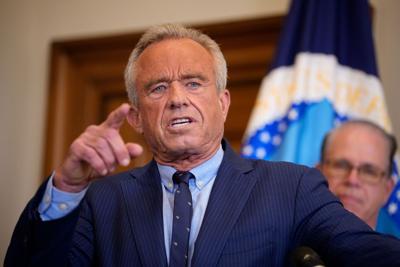

(CNN) 鈥� For decades, pharmaceutical companies have shelled out big bucks to broadcasters to place ads between TV segments. But a pair of policies being considered by US Health and Human Services Secretary Robert F. Kennedy Jr. could change that and leave broadcasters in financial straits.
would make it significantly more difficult and expensive for drug companies to push their products across broadcasters鈥� airwaves, according to a Bloomberg report on Tuesday. The policies look to either mandate that advertisers elaborate on the risks posed by their drugs 鈥� forcing ads to be longer and, therefore, more expensive 鈥� or bar drugmakers from writing off direct-to-consumer ads as business expenses on their taxes, also padding the bill, Bloomberg reported.
Drug ads, which are illegal in most countries, have been a hallmark of US television since the 1980s. By raising the bar on pharmaceutical ads, the Trump administration threatens a crucial revenue source for broadcasters.
$5.15 billion on TV ads in 2024, a significant figure considering found that drugmakers spent almost $14 billion on direct-to-consumer ads in 2023. Despite leaner audience numbers, linear television saw , which reached $3.4 billion during the first eight months of 2024, an 8.1% year-over-year increase.
were split across news broadcasters, including MSNBC, CBS News, CNN and Fox News, according to .
Kennedy has long criticized the pharmaceutical industry鈥檚 ability to directly advertise to consumers, which he argues leads to Americans鈥� greater use of prescription medications. HHS acknowledged it is examining the issue but said no final decisions have been made.
鈥淎s Secretary Kennedy has consistently emphasized, direct-to-consumer pharmaceutical advertising must prioritize accuracy, patient safety, and the public interest 鈥� not profit margins,鈥� HHS spokesperson Andrew Nixon said in a statement, adding that the department is 鈥渆xploring ways to restore more rigorous oversight and improve the quality of information presented to American consumers.鈥�
鈥淒irect-to-consumer (DTC) advertising is designed to provide information backed by fact-based research, so patients are better informed about their health care and treatment options,鈥� Sarah Ryan, a spokesperson for the major industry trade association Pharmaceutical Research and Manufacturers of America (PhRMA), said in a statement. 鈥淲e believe policymakers should ensure patients have access to the information they need to make health care decisions.鈥�
The pair of policies would affect broadcasters airing entertainment and news alike. While news broadcasters鈥� finances are buttressed by several sources of income 鈥� including ad revenue, licensing fees, cable and satellite fees and digital subscriptions 鈥� disincentivizing direct-to-consumer drug ads would harm traditional broadcasters and cable companies. News broadcasters have struggled for years as digital platforms, including social media platforms and streaming giants, have peeled away their ad income.
After in November, the UBS Global Media and Communications Conference that 鈥渋t would take an enormously draconian ban on it for it to really have an impact.鈥�
鈥淔rom a quantitative perspective, it鈥檚 low, single-digit percentage of our overall revenue,鈥� Tomsic said of Fox Corp鈥檚 drug ads. Fox did not provide a comment for this story at the time of publication.
Disney, ABC News and MSNBC did not respond when asked how the policies would affect their businesses. NBCUniversal, NBC News, Paramount, CBS News and Warner Bros. Discovery (CNN鈥檚 parent company) declined to comment.
President Donald Trump has attempted to exert control over drug industry advertising in the past. During his first term, HHS that would have required drug makers to include their list prices in TV ads, but a the effort, saying the agency had overstepped its authority. It was a centerpiece of Trump鈥檚 efforts to lower drug prices at the time.
While cutting drug costs is not as high a priority this term, Trump has signed two that aim to target . One of them called for HHS to explore facilitating pharmaceutical companies鈥� ability to directly sell their drugs to patients at the 鈥渕ost-favored-nation price,鈥� which is tied to lower prices paid in other developed countries.
The Trump administration is not alone in targeting drug ads this term. , a group of legislators led by Senators Bernie Sanders, an independent from Vermont, and Angus King, an independent from Maine, introduced a bill that looked to ban drugmakers from promoting their products on direct-to-consumer channels. Instead of an outright ban, HHS鈥� policies would strong-arm drug advertisers into submission, avoiding costly legal battles that would play out in the courts.
The US Food and Drug Administration established strict guidelines for TV drug ads in 1985, mandating that they include the drugs鈥� side effects. It wasn鈥檛 until 1997, when , that the ads really took off. There is no cap on how many or how often broadcasters can run drug ads.
Drug stocks dipped following Bloomberg鈥檚 Tuesday report, with Johnson & Johnson () down 2.69 points, Pfizer () down 0.40 points and AstraZeneca () down 2.47 points at the time of publication.
The-CNN-Wire
鈩� & 漏 2025 Cable News Network, Inc., a Warner Bros. Discovery Company. All rights reserved.